Monday, May 10, 2010


Overpopulation
Jasmine Bell
04-26-10
My research discusses the problem of overpopulation and what happens when we have too many people and not enough natural resources to support them. In this paper you
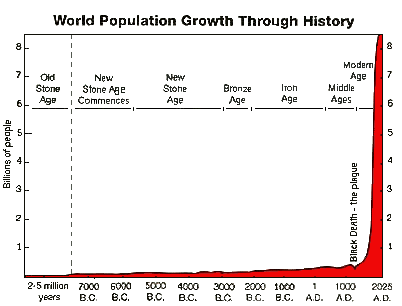
will read about the fall of civilizations, natural disasters, and how we could fix it. About 2000 years ago the world was estimated at 300 million people. The population was scattered and most of the world's population existed in the eastern part of the world. It wasn't until the 1800's that the population grew to 1 billion; we were only growing at a rate of one percent each year. During the Industrial Revolution humans invented new medicines and other technology that helped us live long enough to produce more children. As a result growth rates went from one percent each year to 2.4 percent, growing at an exponential rate. “Scientist have estimated by the year 2050 we will reach a population of 9 billion people most of which will come from second and third world countries”. Overpopulation is a problem because it has led to the downfall of civilizations, global warming and not having enough resources to support everyone. We either need to have serious reduction in demand for resources or we need to have zero population growth. This will only work with dedication. We will have to make certain something like putting a child cap law out is actually safe for the population. We never know when a natural disaster will strike or a plague, and with the recent earthquakes it may or may not be a good idea. If we don’t do anything about the problem of overpopulation we could have a major problem which would lead to another lost civilization. If we fix the problem before instead of after then we may have hope after all.

This is my pull quote “Scientist have estimated by the year 2050 we will reach a population of 9 billion people most of which will come from second and third world countries”.


"Human Populations." The Global Change Program at the University of Michigan. N.p., n.d. Web. 10 May 2010. .

Monday, May 3, 2010

Bruschetta with Tomato and Basil Recipe

One of the things Sophie and I wanted to make was Bruschetta. A recipe called Double Tomato Brushetta calls for the following... I think Bruschetta is a tasty way to make an healthy appetizer.


Ingredients
6 roma (plum) tomatoes, chopped 1/2 cup sun-dried tomatoes, packed in oil 3 cloves minced garlic 1/4 cup olive oil 2 tablespoons balsamic vinegar 1/4 cup fresh basil, stems removed 1/4 teaspoon salt 1/4 teaspoon ground black pepper 1 French baguette 2 cups shredded mozzarella cheese

Directions
Preheat the oven on broiler setting.
In a large bowl, combine the roma tomatoes, sun-dried tomatoes, garlic, olive oil, vinegar, basil, salt, and pepper. Allow the mixture to sit for 10 minutes.
Cut the baguette into 3/4-inch slices. On a baking sheet, arrange the baguette slices in a single layer. Broil for 1 to 2 minutes, until slightly brown.
Divide the tomato mixture evenly over the baguette slices. Top the slices with mozzarella cheese.
Broil for 5 minutes, or until the cheese is melted.

Double Tomato Bruschetta
Servings Per Recipe: 12

Amount Per Serving

Calories: 215

Total Fat: 8.9g
Cholesterol: 12mg
Sodium: 426mg
Total Carbs: 24.8g
Dietary Fiber: 1.6g
Protein: 9.6g

Wednesday, April 28, 2010

food inc

Jasmine Bell

04-27-10

Food Inc Reflection

Food Inc was definitely an eye opener for me; I was able to see food in a different way. Though it did not make me want to go vegetarian, I now am more conscious of where I get my food from. I thought it was horrible how the animals were being treated like they weren’t worth anything. If they are going to use the animals they should at least treat them respect. I thought it was amazing how much meat fast food places like McDonalds use; it said that McDonalds buys the most meat. With jobs losses and the economy going down I could see how families turn cheap food like the dollar menus. It’s hard to find cheap healthy food in this day in time and not everyone is fortunately not everyone has places like Trader Joes or Henry’s in their neighborhood. If we want to change the way we eat, we have to make places like these in all neighborhoods and not just rich areas. I suggest that we have a dollar menu for healthy food also. Maybe if healthier food was cheaper than more people would want bye it. I mean if I had a choice of choosing off the dollar menu and bye a whole meal for under five dollars or buying just a salad for five dollars or more I would chose getting something off the dollar menu. Not only is it cheap but you get more out of it. My overall question would be what we are willing to give up in order becoming healthier. We have to be willing to go out of our way if we want healthier food and it should be that way. Everywhere a fast food place is there should be a healthier alternative restaurant right next to it.

Thursday, February 25, 2010

population control:peer review sources

"Human influence on the planet has increased more human population"
Our population has increased a lot and because of that we have more problems becasue we are contributing more than we put out. Acording to this article by JSTOR from 1860-1991 human use of energy went from 1 billion megawatt hours per year to 93 billion megawatts hours per year and that is probably way over the limit now.
".....In 1992 assumed that the Worldwide average number of children born to a women during her lifetime at current birthrates would fall to 2.5 children per women...by 2050 the number would in increase to 12.5 billion.

This is very interesting how population goes. Its a bad thing that we are becoming over-populated, but at the same time we dont want to limt so much that we become under-populated so how do we fix the problem with creating a even bigger problem?


Another reading that I read was a short passage of a critique of someones writing on population control. One quote that stuck out to me was "population in different trophic levels are expected to differ in the methods of control." It stuck out to me because I don't quite understand what it means and i that's something I can further study on. Other things that came up in the reading was carnivore and herbivore and how than stand with the whole population control.

Cites
Cohen, Joel E. Population Growth and Earth's Human Carrying Capacity. Publication. Web. http://www.homepage.montana.edu/~wwwbi/staff/creel/bio480/cohen.pdf.

The "Balance of Nature" and "Population Control"P. R. Ehrlich and L. C. BirchThe American Naturalist, Vol. 101, No. 918 (Mar. - Apr., 1967), pp. 97-107 (article consists of 11 pages)Published by: The University of Chicago Press for The American Society of NaturalistsStable URL: http://www.jstor.org/stable/2459443

Monday, February 22, 2010

Nate Lewis

Nate Lewis discussion on energy and climate change started get interesting towards the end once he started to name the energy sources and which ones were best to be used. The whole was a little confusing though when he mentioned terawatts and how energy is converted by a certain number of terawatts I was like whoa what does all this mean and I am still confused on that but after reviewing my notes i understand it but more.
Something that was interesting was when he mentioned that renewable energy is good all idea in all but we would still need some technology to create. We have trying to promote renewable energy and not even thinking about how money and human energy it would take just to create the energy needed to power everything.

Thursday, February 11, 2010

population growth and climate change

Something that is interesting to me is population growth and how it is affecting our planet. I think it is interesting that we are getting to the point where the earth is over populated and i would like to do more research on it. I don't know exactly what topic in population growth I would like to do but I know its something I'm interested in studying more of. I read a few articles and saw a few growth maps, what interested me the most is a map of the world 2000 years ago. There were only 300 million people on earth and by 1995 it when up to approximately 6 billion Asia holding 61 percent in population. Of course this number has went up and is now affecting our food,water, and shelter.

"Math in Daily Life -- Population Growth." Teacher Professional Development and Teacher Resources by Annenberg Media. Web. 12 Feb. 2010. http://www.learner.org/interactives/dailymath/population.html.


"By 1990, that rate was down to 1.5%, and by the year 2015, it's expected to drop to 1%. Family planning initiatives, an aging population, and the effects of diseases such as AIDS are some of the factors behind this rate decrease." This quote was interseting it says that instead of population increasing as we thought it would it will decrease by the year 2015 due to health and aging. I was glad I was able to find this quote because now I am able to compare and contrast my information. I somewhat believe this data and it does make sense but I also heard that for every person that dies a person is born so regardless if someone dies we would just be replacing them with someone else. So maybe this is not an accurate asumption.


"Human Populations." The Global Change Program at the University of Michigan. Web. 12 Feb. 2010. http://www.globalchange.umich.edu/globalchange2/current/lectures/human_pop/human_pop.html#carrying%20capacity.


This website showed a lot of different graphs and maps of populatation growth and why it is continuing to grow. A part that struck me was fertilty growth. "the current growth of population is driven by fertility." They showed a map of the world what this map shows is the total fertility growth around the world during 1990

Wednesday, January 27, 2010

Peaches yummmyyyyyy


  • What sort of plant is it? Vegetable, Fruit, Root crop, tree, bush etc.
    The peach is a fruit that grows from a deciduous tree

    What is the growing season for this plant
  • Peach plants grow very well in a fairly limited range, they have a chilling requirement that tropical areas cannot satisfy, and they are not very cold-hardy.
  • The trees themselves can usually tolerate temperatures to around −26 °C to −30 °C.

    Should it be grown from seed? If so how long does it take to germinate? Does it require any special preparation? (ex. some seeds need to be frozen before they will germinate?

  • It is also possible to grow a tree from either a peach or nectarine seed, but the fruit quality of the resulting tree will be very unpredictable.

  • Peaches are best planted in early winter, as this allows time for the roots to establish and be able to sustain the new spring growth. When planting in rows, plant north-south.

  • Peach trees require a constant supply of water and this should be increased shortly before the harvest. peaches taste best when you water it seasonal.

  • Peaches have a high nutrient requirement, needing more nitrogen than most other fruit trees.
  • An NPK fertilizer can be applied regularly, and of poultry manure in autumn soon after the harvest will benefit the tree.
  • How long does this plant take to go from seed to harvest? Does it make sense for the time scale of this semester?…does it matter? Maybe you would still like to think about how it might benefit the garden in the long term.
    Depending on climate and cultivar, peach harvest can occur from late May into August; harvest from each tree lasts about a week.

    How much space does it require to grow and harvest a reasonable amount?
  • Trees grown in a sheltered and south-facing position in the southeast of England are capable of producing both flowers and a large crop of fruit.
  • Can you find any information about good companion plants that should grow along with it?
    The nectarine is a cultivar group of peach that has a smooth skin.
  • Last, but certainly not least, provide at least one other interesting fact about this plant.
  • In China, the peach was said to be consumed by the immortals due to its mystic virtue of conferring longevity on all who ate them.